
Poets Of The Great War
In his book, “The Great War & Modern Memory”, author and WWII veteran Paul Fussell drew on the connections between the language and culture of the First World War, particularly in Great Britain, to the actual battlefield realities its soldiery were burdened with. It was a seminal work, dedicated to a certain Sgt. Hudson, who was Fussell’s company second-in-commmand. (Sgt. Hudson died due to shrapnel wounds, physically next to Fussell when hit on the French-German border, in January, 1945.) Through Fussell’s book, published in the mid 1970’s, the works of three major authors/poets re-entered into literary consciousness: Robert Graves, Wilfred Owen, and Siegfried Sassoon. In these three writers, Fussell sought to come to grips with his own memories of loss and trauma as a result of his Second World War experiences. But more importantly, the entire modern anti-war movement in the English-speaking world, at least in a literary and/or poetic sense, was arguably ignited by these three men and their writings. All three were members of the British Expeditionary Force (BEF) on the Western Front, and their observations stripped away all the romance, adventure and glory that war had been adorned with up to that point, revealing it for the experience it truly was. All future writers on war would take note, and paeans to the glories of combat would give way to gritty warnings of its damaging effects, both physically and psychologically.
Glory
But and if he escape the doom of outstretched Death and by victory make good the splendid boast of battle, he hath honour of all, alike young as old, and cometh to his death after much happiness; as he groweth old he standeth out among his people, and there’s none that will do him hurt either in honour or in right; all yield him place on the benches, alike the young and his peers and his elders. This is the prowess each man should this day aspire to, never relaxing from war.–Tyrtaeus, 650 B.C. (est.)

In Alfred Lord Tennyson’s epic poem, “The Charge of the Light Brigade”, he recounts the doomed charge of British soldiers in a brave but futile push in a battle during the Crimean War. Of this, he wrote:
When can their glory fade?
O the wild charge they made!
All the world wonder’d.
Honour the charge they made!
Honour the Light Brigade,
Noble six hundred!
Doomed they were, but still given a gloried, posthumous varnish. Poetry and literature, from Antiquity through the 19th Century, was typically written in this manner: They’d “given” their lives for a greater cause, their bravery echoing through eternity as a result. (Paul Fussell referred to Tennyson’s writings as “Arthurian”[1], referencing–quite obviously–the legend of King Arthur.) Chivalry, courage, valor, glorious death on the battlefield, one’s honor resounding through the ages…these were the sentiments conveyed by poets dating back to the ancient Greeks like Homer and Tyrtaeus, straight through William Shakespeare, and to poet laureate of the British Empire, Alfred Lord Tennyson. However, the First World War, fought between 1914 through 1918, was a different kind of war, as technology had outpaced strategy. Commanders utilizing outdated military stategems had not the military knowledge or experience to deal with rapid-fire machine guns or powerful artillery pieces. A far cry from cavalry charges, uniforms bright red, brass buttons and swords agleam, this. And so a four year slaughter commenced, a “no man’s land” developed: a line stretching from the English Channel to the Swiss border, with trenches no further than a few hundred (or less) yards away from each other, no ground permanently gained by either side for four years.
Robert Graves, Siegfried Sassoon, and Wilfred Owen, through their works, obliterated the glorification of war, perhaps for all time. All three saw heavy combat, and lived life in the insalubrious, grubby trenches that were endemic of the Western Front. All intersected with each other at certain points during the war. Graves had met Sassoon as a result of being officers in the same battalion. Sassoon met Owen whilst convalescing at Craiglockhart War Hospital in Scotland, a facility specifically set up to treat neurasthenia, or what is commonly known as “shell shock”. All were upper-middle class young men, educated in private (or as the British refer to it, public) institutions, and schooled in the classics of poetry and literature. Sassoon and Graves, and later Sassoon and Owen, became good friends due to their shared educational and social backgrounds. Graves was the first to grow disillusioned by the war; Sassoon would still cling to his idealism a bit longer. Early on, whilst comparing writings, Sassoon would tell Graves that his writings were too harsh in their depictions of war. Graves, the more experienced of the two, said to Sassoon that he’d soon see it differently: “I had one or two drafts…and showed them to Siegfried. He frowned and said that war should not be written about in such a realistic way…Siegfried had not yet been to the trenches. I told him, in my old-soldierly manner, that he would soon change his style.”[2] He did.
Robert Graves–“Wars don’t change except in name”
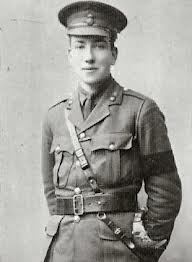
Robert Graves survived the war. He would go on to write “Goodbye To All That“, a semi-autobiographical account of his wartime experiences. Some of its veracity was questioned, but Graves maintained any semi-truths were inserted into its texts to reach “higher truths” about the war. It remains amongst the most important pieces of anti-war literature of all time nonetheless. He is well-known for the aforementioned tome, as well as his literary contributions, “I, Claudius”, “Claudius the God”, and his translations of Omar Khayyam’s “Rubaiyat”. Lesser known–but just as important–is his poetry, where the echoes of his experiences can be read throughout. In one such poem, Graves writes of as a chance meeting with a certain Corporal Stare. On leave from the war and throwing a dinner for his staff, a haunting encounter occurs:
Five hungry lads welcomed the fish
With shouts that nearly cracked the dish;
Asparagus came with tender tops,
Strawberries in cream, and mutton chops.
A good time being had by all, they broke into a post-dinner, drunken revelry:
We bawled Church anthems in choro
Of Bethlehem and Hermon snow,
And drinking songs,
a mighty sound
To help the good red Pommard round.
Stories and laughter interspersed
Then, through the window, Graves and his men see a departed comrade-in-arms: Corporal Stare. “Badges, stripes, and medals all complete, he staggered up the street”, as if still alive. But he wasn’t. He’d been killed the month before, torn apart by machine gun fire. But there he was:
He paused, saluted smartly, grinned,
Then passed away like a puff of wind,
Leaving us blank astonishment.
The song broke, up we started,
leant out of the window—nothing there,
Not the least shadow of Corporal Stare,
Only a quiver of smoke that showed
A fag-end* dropped on the silent road.
*Note: British slang for a cigarette butt.
In “The Next War”, Graves confronts those youngsters who see battle-glory in their future with cold advice: they will not like what they’ll find.
You young friskies who today
Jump and fight in Father’s hay
With bows and arrows and wooden spears,
Playing at Royal Welch Fusiliers,
Happy though these hours you spend,
Have they warned you how games end?
From that same hour by fate you’re bound
As champions of this stony ground,
Loyal and true in everything,
To serve your Army and your King,
Prepared to starve and sweat and die
Under some fierce foreign sky,
And then the final punch, the coup de grace:
By the million men will die
In some new horrible agony;
And children here will thrust and poke,
Shoot and die, and laugh at the joke,
With bows and arrows and wooden spears,
Playing at Royal Welch Fusiliers.*
*Note: Graves was a captain in the Royal Welch (Welsh) Fusiliers.
Siegfried Sassoon–“Mad Jack”

As for Sassoon, his works did turn out to be significantly harsher, even more than Graves’. As his battlefield experiences accrued, he became battle-hardened. Psychologically pushed to the edge, he grew into an epic risk-taker. He acquired the sobriquet “Mad Jack” for his actions, and betrayed a sort of death-wish. This became particularly so when he was informed of the death of his brother Hamo, who was killed in action in the Gallipoli assault. He also earned a Military Cross, one of the highest military awards for gallantry in the British armed services. If Graves still maintained a sort of eloquence of phrasing, Sassoon went for stunning, straight wording, eloquence stripped away:
‘Good-morning; good-morning!’ the General said
When we met him last week on our way to the line.
Now the soldiers he smiled at are most of ’em dead,
And we’re cursing his staff for incompetent swine.
‘He’s a cheery old card,’ grunted Harry to Jack
As they slogged up to Arras with rifle and pack.
But he did for them both by his plan of attack.
Sassoon’s works spare nothing in their depictions of the effects of war. Combat was only one dimension he explored. There was the crushing psychological effects of trench life, depicted in “Suicide in the Trenches”:
I knew a simple soldier boy
Who grinned at life in empty joy,
Slept soundly through the lonesome dark,
And whistled early with the lark.
In winter trenches, cowed and glum,
With crumps and lice and lack of rum,
He put a bullet through his brain.
No one spoke of him again.
Sassoon wrote of the lies told to a grieving mother by the officer who delivered the condolences of her son’s death in battle. The officer fills her head with tales of her boy’s non-existent bravery, in the poem “The Hero”.
‘Jack fell as he’d have wished,’ the mother said,
And folded up the letter that she’d read.
‘The Colonel writes so nicely.’ Something broke
In the tired voice that quavered to a choke.
She half looked up. ‘We mothers are so proud
Of our dead soldiers.’ Then her face was bowed.
Quietly the Brother Officer went out.
He’d told the poor old dear some gallant lies
That she would nourish all her days, no doubt
For while he coughed and mumbled, her weak eyes
Had shone with gentle triumph, brimmed with joy,
Because he’d been so brave, her glorious boy.
He thought how ‘Jack’, cold-footed, useless swine,
Had panicked down the trench that night the mine
Went up at Wicked Corner; how he’d tried
To get sent home, and how, at last, he died,
Blown to small bits. And no one seemed to care
Except that lonely woman with white hair.
In “Decorated”, a poem written about a scene he witnessed whilst in civilian life, Sassoon observes a vicious street fight. The murderous winner of this brawl kills five adversaries. The crowd loves him for it. He may be a violent, drunken bum, but he’s a war hero. The man, deranged due to combat fatigue, can do no wrong in the eyes of his civilian admirers:
I watched a jostling mob that surged and yelled,
And fought along the street to see their man:
Was it some drunken bully that they held
For justice – some poor thief who snatched and ran?
I asked a grinning news-boy, ‘What’s the fun?’
‘The beggar did for five of ‘em!’ said he.
‘But if he killed them why’s he let off free?’
I queried – ‘Most chaps swing for murdering one.’
He screamed with joy; and told me, when he’d done –
‘It’s Corporal Stubbs, the Birmingham VC!’*
*Note: The Victoria Cross is the highest award for conspicuous bravery under fire in the British military. It is the equivalent of the Congressional Medal of Honor.
On leave from the front in July of 1917, Sassoon typed a letter of protest against the war. First published in newspapers throughout Great Britain, it eventually found its way to the House of Commons, where it was read aloud to a stunned–and in many cases, indignant–assembly of MPs, and published in the Times of London. Titled “Finished With The War: A Soldier’s Declaration”, Sassoon said he was “making this statement as an act of wilfull [sic] defiance of military authority because I believe that the war is being deliberately prolonged by those who have the power to end it. I am a soldier, convinced that I am acting on behalf of soldiers.” This was treasonous talk, and a lesser connected, less decorated individual would’ve been tried and shot as a traitor; indeed, many had already met that fate in the field for far less serious offenses. But Sassoon was already a war hero whose exploits were already the stuff of legend. Certainly being awarded the Military Cross kept him from an otherwise certain fate in front of a firing squad. It was obvious to those in high offices that Sassoon’s execution would not have played well on the home front, not with casualty notifications arriving with alarming frequency to homes throughout Britain. Robert Graves, also politically connected, lobbied on Sassoon’s behalf to avert a capital sentence. (Sassoon supposedly was unhappy with Graves for interceding on his behalf.) But Sassoon, the British government, and BEF high-command found an out: he was declared mentally unfit to report back to duty due to shell-shock and sent to Craiglockhart War Hospital, a facility specializing in the treatment of the aforementioned condition. It was there that he met 2nd Lieutenant Wilfred Owen, fresh off the line and in a state of severe battle fatigue.
Wilfred Owen–The Doomed Youth

Sassoon and Owen became fast friends. Owen was clearly suffering from shell-shock; he was once caught in a trench for several days, unable to exit due to incessant enemy fire on his position. His predicament was made considerably worse by the dead officer whose remains were never more than a few feet away the whole time. He was a great admirer of Sassoon’s poetry and his stance against the war. Like Sassoon, he felt the nagging guilt every good officer had for being away from his men, unable to keep them safe. Sassoon mentored Owen, nurtured his talent, made suggestions and gave encouragement if and when necessary. Owen, also an educated, intellectual officer, was a kindred spirit for Sassoon. It was at Craiglockhart that Owen wrote the first draft of what is perhaps the most well-known war poem of all time, the one that some scholars called “the poem that changed poetry forever”.
Owen had been subjected to gas attacks whilst on the line. The horror of it all is most effectively conveyed in “Dulce et Decorum Est”, a title taken from the Roman lyrical poet Horace’s Odes. (Dulce et decorum pro patria mori: it is sweet and fitting to die for one’s country, reads the English translation of this Latin phrase.) The dark irony of the title is revealed in the words thereafter. The first part of the poem sets the scene. First, exhaustion:
Bent double,
like old beggars under sacks,
Knock-kneed, coughing like hags,
we cursed through sludge,
Till on the haunting flares
we turned our backs
And towards our distant rest began to trudge.
So exhausted, Owen’s company was, that they’re oblivious “to the hoots of tired, outstripped Five-Nines that dropped behind.” (Five-Nines: gas shells.) “Drunk with fatigue” though they were, an immediate adrenaline rush ensues, the survival instincts in full effect, an intense desperation to get the gas masks on before the chlorine shells release their toxic fumes:
Gas! Gas! Quick, boys!—An ecstasy of fumbling,
Fitting the clumsy helmets just in time;
But someone still was yelling out and stumbling,
And flound’ring like a man in fire or lime…
Dim, through the misty panes and thick green light,
As under a green sea,
I saw him drowning.
Desperation, helplessness, a mad and futile attempt at survival, “In all my dreams, before my helpless sight, He plunges at me, guttering, choking, drowning.” This is what the effects of a gas are on a man, one too unfortunate to have gotten his mask on quick enough. Owen witnesses it, first-hand:
If you could hear, at every jolt, the blood
Come gargling from the froth-corrupted lungs,
Obscene as cancer, bitter as the cud
Of vile, incurable sores on innocent tongues,–
My friend, you would not tell with such high zest
To children ardent for some desperate glory,
The old Lie: Dulce et decorum est
Pro patria mori.
Goodbye To All That
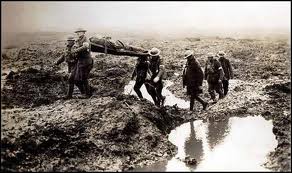
Robert Graves, having survived the war, eventually made his way to Spain. He pursued a career in writing, and managed to secure some semblance of financial security through the royalties of his memoir. He was in and out of academia. He married, divorced, remarried, relocated from England to Spain, then back again, if only to avoid the Spanish Civil War in the 1930’s. He eventually spent the remainder of his life in Spain. His son, John David Graves, would lose his life in the Second World War in 1943, killed in action. He died in 1985, in Majorca, Spain.
Siegfried Sassoon became literary editor of The Daily Editor, and dabbled in socialist politics. Though involved in a number of same-sex relationships, he later married and fathered a son. He authored a fictional biography, Memoirs of a Fox-Hunting Man, and later a genuine, three volume biography of his life, which was critically acclaimed. He was bestowed with an Commander of the Order of the British Empire (CBE) in 1951; a significant turn, considering his published, open defiance of the British government and military command during the war. He died in 1975, age 81.
Wilfred Owen did not survive the war. Despite the entreaties of his friend Siegfried Sassoon to opt out of the war–he had been given the option of a non-combat assignment by British military command–Owen decided to go back front-line duty in late 1917. He couldn’t reconcile in his mind that he was safe in England at the same time the men he left behind in France were still in peril on a daily and nightly basis, and so he returned to his unit. He left England without telling Sassoon he was going back to the Western Front; he knew Sassoon would make every attempt to stop him, and could well have succeeded, and so he bid Sassoon no farewell. He was killed in action on November 4th, 1918, a mere seven days before the cease-fire of November 11th. His parents received his death notice as church bells in Oswestry, England rang in celebration of the declared armistice. Siegfried Sassoon later commented in his autobiography that he was “unable to accept [Owen’s] disappearance philosophically.”
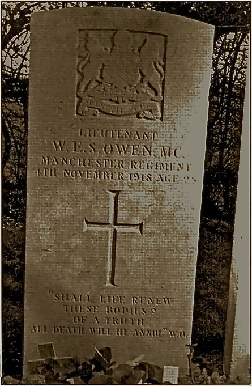
Lieutenant W.E.S. Owen, M.C.,Manchester Regiment
4th November, 1918, Age 25
“Shall Life Renew These Bodies? Of a truth all death will annul”-W.O.
All three are commemorated, along with thirteen other “war poets”, at Poets Corner, Westminster Abbey
Footnotes:
[1] Fussell, Paul The Great War and Modern Memory, pg. 21 (Oxford University Press, 1975)
[2] Graves, Robert Goodbye To All That, pg. 174-175 (Doubleday-Anchor Books, 1929)
References:
Fussell, Paul Doing Battle: The Making of a Skeptic (Backbay Books, 1996)
BBC Documentary: Wilfed Owen-A Remembrance Tale, 2012
 Plutarch's Ghost