
On Church & State…And Separation Thereof
by Christopher J. Valentine
And In the Beginning….
This “separation of Church & State” concept….where did it come from, why does it exist, and how did it come to pass that this is an overriding concept of our lovely republic? Very simple this phrase, yet very complex. Long historical precedents got us to this point, but it started with one very pithy and evasive utterance, “Render therefore unto Caesar the things which are Caesar’s; and unto God the things that are God’s”. That was the answer to a trick question, you see: legend has it that this question was posited to Christ, with both answers perilous:
Jesus was asked the question about paying taxes in hope that he would answer “yes” or “no”. Answering “yes” would have left him open to the accusation that he was in opposition to Jewish resistance to the Roman occupation and therefore (given the assumption by the Jews that they still held privileged nation status with God at this time) against God, too. Answering “no” would have given those present an opportunity to report him to the Roman authorities as someone who was trying to incite a revolt. His questioners had assumed that there was an inevitable (and hazardous) dichotomy between discharging one’s obligations to the state and discharging one’s obligations to God, but Jesus refused to confront the dichotomy as framed by his hostile questioners and instead pointed to the assumptions behind it. [1]
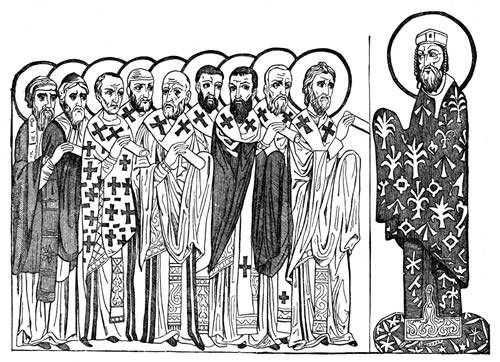
Constantine the Great at the Council of Nicea, 325 A.D.
Clever one, that JC. But though Christianity (obviously) was founded the moment Christ started ministering (and someone other than himself started listening), the concept of separation of Church & State took a lot longer to take hold. The first wholly Christian government, realized when the Eastern Roman Emperor Constantine made a plea to “the Christian god” for victory (in return for conversion of his empire) over his Western Roman Emperor/competitor Maxentius at the Battle of Milvian Bridge in 312 AD, was founded when Constantine magically saw a cross in the sky (whilst dreaming) prior to military engagement and, even more magically, won. A deal’s a deal, thought Constantine, and anyway, the empire was being swept up in Christian fervor, particularly amongst the humiliores, who’s lives were–charitably put–a miserable grind from birth to (in most cases, early) death. (The prospect of a better afterlife would obviously have tremendous appeal to this lot.) But though Constantine was the first openly Christian emperor, what to do about that pesky “render to Caeser/render to God” thing? After all, in pagan Rome, the emperor was also THE pontifex maximus–the head of the state religion, in addition to being head of everything else. What now? Simple: he did as any good Roman emperor would do–he held the title, and disregarded that famous “render to Caesar/render to God” comment. There it would stay in the list of imperial titles held by the emperor until close to fifty years later, when a successor (Gratian) acceded the title to an actual pope, though certainly not with much power attached to it. (In the Eastern Roman Empire, the emperor retained the title pontifex maximus for many years after, the Eastern Roman Empire living well past the Western Roman Empire by approximately one-thousand years. The Eastern Roman Empire resided in what is now modern-day Turkey, its capital Constantinople, now known as Istanbul.
And Then There Was…Darkness

The Sack Of Rome, 410 A.D.
The fall of the Western Roman Empire is usually traced to the year 410 AD, when Alaric, King of the Visigoths, sacked Rome. All of Western & Central Europe was thrown into the dark for close to a thousand years. The Roman Catholic Church continued to expand and develop at this point, but it was vulnerable to the thuggishness of warlords, castellans and kings bent on controlling papal decisions. The old Roman bureaucracy, capable as it was of maintaing social order and lawfulness for approximately a millenium, was dead, and in its place sprouted chaos, violence, feudal warlord-ism–an entire continent predicated on gangsterism. The Church would minister and expand, adding formerly pagan peoples like the Poles and the Hungarians to its roster of followers, but it had no real power. Should a king act in an “un-Christian” manner–and rare the king that didn’t–a pope was powerless. The appointment of bishops–important positions to midieval kings, as they maintained social order and acted as feudal lords themselves–was the domain of kings, and popes could only advise and approve said appointments; to do otherwise risked disposal of said pope. They were, in every sense of the word, puppets to be controlled by the most powerful warlords and/or kings of the day.
Fast forward to year 800 AD.
Charlemagne, King of the Franks and the most powerful king in Europe, was on friendly terms with the papacy, and took it upon himself to protect it (and Rome). For this he was crowned Holy Roman Emperor, on Christmas Day, 800 AD. A bit of papal manipulation, this, for the pope at the time (Leo III) had made the cynical calculation that bestowing the (then unheard of) crown of the Holy Roman Emperor would engender said emperor to protect Rome (in perpetuity), and rule over a (theoretically) reconstituted Roman Empire. The papacy now had a protector, but despite eighteen children, Charlemagne had only four legitimate heirs. The Franks had a maddening habit of settling their royal inheritances by splitting kingdoms based on the number of sons produced. An admirable and equitable thing in our modern-day world (removing the sexist element to the equation, mind, as only male heirs got inheritance), but not terribly helpful in the Middle Ages. As luck (or poor luck, depending on where you stood) would have it, Charlemagne’s sons all died young, and only his son Louis survived to inherit the throne. Louis, in contrast to his father, produced three healthier heirs, who immediately squabbled over the scraps of their father and grandfather’s kingdom. In time, the line of Charlemagne, known to history as the Carolingian line, would splinter…its powers divided and lessened with every inheritor.

Charlamagne gets crowned Holy Roman Emperor, Christmas, 800 A.D.
Charlemagne had conquered the pagan Saxons in the 800’s, and over time, the converted Saxons would gain control over wide swathes of Europe. Control over Rome eventually fell into the hands of the Saxon king Henry III, who scrapped three popes in one stroke (1046 AD)–one for the record books, no doubt–and installed “his guy”, Pope Clement II, a fellow Saxon, shortly thereafter. Pope Clement duly returned the favor, crowning Henry III Holy Roman Emperor. The precedent at that point was firmly established–kings control popes, not the other way around. And besides, a pope may claim to be “the vicar of Christ”, but were kings not divinely annointed as well? And who does the warring, and specifically the dying in defense of the Roman church: the pope, or the Holy Roman Emperor? With regards to the pope, Joseph Stalin once famously sniffed–when informed of papal disapproval of his actions in central and eastern Europe post-WWII, “Well, how many divisions does HE have?” A thousand years prior, warlords, princes, and kings could have–and probably DID–posit that question to themselves and their minions, and the answer obvious: none.
Enough Is Enough

Pope Gregory VII, aka Hildebrandt
After centuries of multiple ignominious reigns from popes who bought their way into the position (a practice known as “simony”), a sentiment started to take hold in the Roman Church: reform. Despite Clement II’s ascension to the papacy via Henry III’s power move, Clement took reform seriously, starting with the banning of simony. Clement was duly rewarded for his efforts by having a ten month run, ending in poisoning. (This is historically unverified, but highly likely to have happened.) His poisoner was, in all likelihood, his predecessor, the previously deposed Benedict IX, a man first appointed (through extreme simony) to the papacy at the at age of 18, occupied the office three separate times, and “was generally far too busy indulging his insatiable sexual appetites”[2], and described by Peter Damian, a prominent theologian of the time, as a man who “feasted on immorality”. A spate of popes and counter-popes, some reform-minded, some determined to retain the rotting status quo, ensued. A cross-current of factionalism, a virtual civil war for the soul of the Church, ended with the acclaim of another prominent reform-minded theologian of the time, Hildebrand. Following the death of Pope Alexander II, the people of Rome rose up, weary of the factionalism and corruption endemic to the office, and declared “Hildebrand for pope!”. And so it was done, approval for office by cardinal election being a foregone conclusion. At the heart of Hildebrand’s agenda was this: no more corruption, no more simony, the whole of the Church should be “virgins, marrieds, and those who hold themselves in restraint”[3], as Hildebrand (now known by the papal name assumed upon ascension, Gregory VII) wrote to the Bishop Otto of Constance in a particularly snarky correspondence. No more would bishops or priests be with concubines, wives, mistresses, or have illegitimate children. Furthermore, no more bishops gaining appointment to their posts from kings, princes or warlords; these appointments alone were now the domain of the papacy. An agenda that had been set by a group of reform-minded priests and theologians like Peter Damian and Cardinal Humbert years before was now set for implementation by Gregory VII. Peter Damian referred to Hildebrand as “my holy Satan” for his determination and perceived self-aggrandizement–a title Hildebrand chafed at. One thing was certain, however: he was not to be trifled with. Neither, however, was the Saxon King of Germany and Holy Roman Emperor, Henry IV, who learned what to do with oppositional and cantankerous popes by the actions of his forebears, not the least of whom was his father, Henry III, he of the triple papal wipeout decades before.
Face Off
The Second Coming, or so it was thought at the time, was imminent. The year 1000 AD had mystical implications, for the Anti-Christ was to arrive first, and then the Christ would arrive to vanquish him, with the end of the world and the great rapture to occur…all according to the prophecies of the time. Year 1000 came and went, so then the expectation became the 1100 AD, the year when it would all come to pass. Much like one cleans house in expectation of important guests, the Church needed a good sweeping, and Hildebrand/Gregory VII was just the guy to do it.
Henry IV had other ideas.

Henry IV, Holy Roman Emperor. Not a fan of upstart popes, and particularly not a fan of Hildebrandt, who he refused to address by his papal name, Gregory.
It all came to a head over who would be the Archbishop of Milan. Gregory VII pushed his man for the post, and backed him up with some goonish muscle. The position was traditionally under the control of Saxon kings, not the least of which was his father, Henry III. Henry IV by no means would let this snotty, upstart pope get his way by investing his man in what he considered his territory. Back and forth the position swung, to Gregory’s man, back to Henry’s, street fights erupting in gangland style throughout Milan, Gregory employing his “patarines”, artisans and working men dedicated to his cause, Henry employing his hired goons as well. Henry would consequently convene his Saxon bishops–all his appointments, mind–and elect his own pope. Installation of a hand-picked pope would follow, no doubt with some world-class muscle behind it. Hostile letters went back and forth between Henry and Gregory throughout this struggle. To wit:
Gregory to Henry:
“Gregory, bishop, servant of God’s servants, to King Henry, greetings and the apostolic benediction–but with the understanding that he obeys the Apostolic See [another name for the papacy] as becomes a Christian king…“[emphasis mine]
Henry responding to Gregory:
“[From] Henry, King not by usurpation, but by the pious ordination of God, to Hildebrand, now not Pope, but false monk…” [emphasis mine]
(The tone degenerated accordingly, ending with Henry imploring Gregory to resign at once…)
“I, Henry, King by the grace of God, together with all our bishops, say to you: Descend! Descend!“ [emphasis mine, once again]
Gregory, left no choice, excommunicates Henry. At first, Henry is blase. His plans to depose Gregory and install a vassal pope to do his bidding and preserve the status quo remain unchanged. But in Henry’s bishops, there descends a deep foreboding. Would they risk excommunication with resultant damnation ad infinitum on behalf of their king? Sure, they must’ve thought, he invested us with the requisite staff and ring–the symbols of bishopric investiture, representing the spiritual care and tending of the flock–but what of our own potential excommunication? Indeed, in Henry’s bull of excommunication, Gregory stated with dramatic clarity thus, “I absolve the Christian people of any oath they have taken, or shall take, to him. And I forbid anyone to serve him as king.” [4] Henry’s bishops, in a tizzy and highly “anxious for their own souls, hurried to make peace with Gregory–who, for his part, was diplomatically quick to welcome them back into the fold”[5] But Gregory was playing a deeper, more insidious game: he was supporting Henry’s rival, Rudolf of Swabia, as well as other rebellious Saxon princes licking their chops for an opportunity to knock off Henry and gain the throne. Gregory was looking to do something that had never before been attempted by a pope, and in retrospect, turned out to be a drastic overstepping of boundaries: he was looking for full domination, both politically as well as spiritually, of all of Western Christendom. No more kowtowing to thuggish kings, princes, noblemen and warlords for protection. No more cowering in the face of their swords. Gregory would rip their souls from them and condemn them to the confines of Hell if they dare defy him. There for all to read in Dictatus Papae, published in March of 1075, it stated as much [all italics/bold mine]:
• That the Pope is the only one whose feet are to be kissed by all princes.
• His title is unique in the world
• That he may depose emperors.
• That he himself may be judged by no one.
Not content to leave it at wresting the power of investiture when it came to bishoprics, Gregory was claiming superiority over every king and prince in Europe and beyond, and in Henry’s case, superiority over even a Holy Roman Emperor.
Canossa
Henry, left with Rudolf of Swabia threatening his position, his bishops and noblemen disassociating themselves from him for fear of excommunication, did the only thing he could do: he repented. Seeking out Gregory, who left Rome specifically to conference with Henry’s enemies (in Augsburg, Germany), Henry managed to intercept the pope’s journey at the mountain redoubt of Canossa. High in the mountains, in the dead of winter, Henry stood at the gates of fortress Canossa, barefoot and penitent, awaiting readmittance to the communion of the Church. Gregory, far from feeling self-satisfied about humbling this most haughty of monarchs, had a quandary on his hands: if he took Henry in, allowed him to make a full act of contrition, permitted him to satisfy all acts of penitence, he would have no choice but to readmit him into the good graces of the Church. This in turn would set off feelings of betrayal by the German princes, Rudolf of Swabia primary among them, that he broke his alliance with them. If he did not allow contrition and penitence….well, then what kind of Man of God would do that, worse still…what kind of pope? Was not the central tenet of Christianity forgiveness?

A humbled and freezing Henry awaits his absolution outside the fortress of Canossa.
Gregory left Henry outside the gates of Canossa for three days in the bitter cold of January 1077, high up in the Italian Alps. On the third day, the doors opened. Henry was allowed to make his full confession, perform his acts of contrition, was allowed back into the Church. He was forced to sign the humiliating oath guaranteeing the supremacy of the pope in all matters of investiture, and that he would defend all actions of the pope by force, if necessary. And with that, Henry was readmitted to the Church…but did not regain papal recognition as either King of the Saxons or as Holy Roman Emperor. To regain those titles, Henry would have to fight it out with Rudolf. Leaving Canossa without papal recognition of his position as king would be a slight Henry would not forget.
Gregory’s Reverse
Henry IV set to work on defeating Rudolph of Swabia for the coming years, in Germany and great central Europe. For his part, Gregory was boxed: the Saxon princes, aligning behind Rudolph, indeed felt betrayed by Gregory, who they felt pulled the rug out from under them at a most critical time and when Henry was most vulnerable. For three years a civil war raged between Henry and Rudolph, the pope refusing to publicly support for either man. Eventually, Gregory had no choice but to lay down his bet: Rudolph would be his man, his putative Holy Roman Emperor. It seemed a good wager at the time: Henry was suffering reverses on the battlefield, Rudolph was ascendant, and it also placated those Saxon princes who felt so betrayed by Gregory’s acceptance of Henry’s contrition and subsequent re-communication. But at the Battle of Elster in 1080, Henry IV lost the battle but won the war, for Rudolf lost his life in the engagement. The man at the center of the rebellion–Rudolf–was dead, and support for rebellion against Henry soon petered out.
Henry set about for Rome thereafter, intent on being re-coronated king and emperor. Gregory, defenseless, attempted another excommunication of Henry, but this time it had no efficacy. Gregory soon found himself taking refuge in the Castel Sant’Angelo, a prisoner in his own city, Henry’s forces laying seige. Appeals to another warlord, Robert Guiscard, a Norman who then dominated northern Italy, to come to the aid of Gregory, were received and acted upon. Henry, uninterested in warring with the Norman warlord (if for no other reason than it offered no advantage), withdrew. Robert’s forces, far from being liberators, set about sacking Rome for three days. Gregory was, for lack of a better term, abducted by Robert’s forces from Rome. He died in Salerno, Sicily, exiled from Rome and a “guest” of Robert Guiscard’s, in 1085. His last words, attributed to him or written for him, were thus, “I have loved justice and hated iniquity; therefore, I die in exile.”
Legacy
Gregory, in his dying moments, had failed…or so he thought. But reform of the Church hadn’t failed. The fight over the right of investiture had been settled in 1122 during the Concordat of Worms: no longer could kings appoint bishops with full spiritual and temporal powers. The practice of simony was prosecuted with greater vigor. The Church rid itself of priests and bishops indulging in concubinage, cohabitation, and marriages-on-the-sly. (Though not completely, as evidenced by the conduct of Alexander VI, the Borgia pope, who gained his office through simony and openly retained both wife, children and mistresses.) But the marker had been laid down; the Church could no longer govern its disciples in its previously rotten, immoral condition. And the precedent of independence of the Church from outside, secular interference from warlords and kings bent on turning papal decisions their way, had been set. It didn’t end with Gregory, but rather started. These practices continued, but they were no longer considered commonplace, but rather sinful and aberrant. State could no longer interfere with Church without consequences. That is the legacy of Canossa.
Conversely, the powers of the papacy had been demonstrated to be ineffective in matters of state. Gregory proved himself to be terribly bad at secular politics, as evidenced by his backing of Rudolf over Henry, and by doing so, tearing central Europe into chaos and civil war. In the end, what was established was this: popes can’t do the brutal job of kings, nor can kings do an effective job of tending to the spiritual needs of their people. The whole affair was succinctly put by midieval historian Brian Tierney:
Henry insisted that his authority came from God alone and that only God could depose him–certainly not the pope. But he also insisted that the two swords of spiritual and temporal government should remain separate from one another and did not claim both for himself. His assertion that Gregory alone was guilty of confusing the two orders of government may seem disingenuous since it was the king’s insistence on his right to appoint bishops that caused the whole dispute. But Henry did not maintain, at least in principle, that all spiritual and temporal authority belonged to him as vicar of God. The assertions of both rulers thus fell far short of claims to absolute theocratic power.[6] [Emphasis mine]
One can draw a very clear line through the thousand years since this occurred to our modern-day American republic. Granted, there were countless religious disputes after the investiture controversy, not the least of which was the break from the Church by Martin Luther and his followers close to four hundred years later, followed by Henry VIII of England’s break a few years thereafter, for state, rather than religious, reasons. (Or more accurately, for procreative reasons.) In the end, those that were present at the creation of our republic figured it best, for myriad reasons, to leave the whole state/church fusion, or more accurately–confusion–in the dust, and leave it to the citizenry to make their decisions with regards to worship, or even no worship. As the investiture controversy between Henry IV and Gregory VII so clearly demonstrated, governing by theocratic means was and is an unworkable method of governance. The realization of this sentiment reached its apotheosis in the First Amendment of the Constitution of the United States: “Congress shall make no law respecting an establishment of religion, or prohibiting the free exercise thereof“. Whereas this critical portion of the First Amendment pertained specifically to George III of England being both King and highest official of the Church of England (Anglican Church), and the prohibition of such offices in the new American republic, the first definitive example of the unworkability of a church/state fusion goes right back to the clash between Gregory VII and Henry IV in the 1070’s.
References
[1] The Law of Christ respecting civil obedience, especially in the payment of tribute, John Brown (London: William Ball, 1839) 3rd. ed, p. 182
[2] The Forge of Christendom, The End of Days and the Epic Rise of the West, Tom Holland pg. 258.
[3] Letters of Gregory to Otto, Bishop of Constance, December 1074 AD, translated by E. Emerton, The Correspondence of Pope Gregory VII, pg. 52-53.
[4] Gregory VII, Register 3.10a.
[5] The Forge of Christendom, The End of Days and the Epic Rise of the West, Tom Holland, pg. 369
[6] The Crisis of Church & State 1050-1300, Brian Tierney, pg. 57
 Plutarch's Ghost


Very interesting dynamic here — one would have to think Gregory had quite a sly plan which he was just unable to pull off — had he been able to would Western Christian nations today look alot like Fundamentalist Islamic countries???
No way of knowing. History has a way of putting a “what if” in people’s minds.